Water for coffee machines in the Gulf
Most machines that come back were not broken by coffee. They were closed by stone, or eaten by water that was too soft.
Two opposite problems
Hard water leaves scale: in the thermoblock channel, on probes, in valves. Flow falls, temperature swings, the pump works against a wall.
Very soft water, desalinated or reverse osmosis without minerals, leaves no scale, but it is hungry. It attacks brass and copper, some level probes do not see it, and the coffee tastes empty.
A machine wants something in the middle. Most manufacturers ask for a total hardness of about 50 to 100 mg/l and a neutral pH.
What comes out of the tap
General picture. Measure your own, a strip costs less than a coffee.
| Source | Typical | What to do |
|---|---|---|
| City network, desalinated | Soft to medium, chlorine | Carbon filter, small softener |
| Building roof tank | As network, plus sediment and heat | Sediment filter first, then carbon |
| Well or tanker | Hard, changing | Softener by litres, test every month |
| 5-gallon bottle | Soft, stable | Fine for tank machines, check level probes |
| Reverse osmosis unit | Very soft | Remineralisation cartridge, otherwise corrosion |
Filter by litres, not by months
A cartridge has a capacity in litres for a given hardness. A café with 200 cups uses about 25 litres a day including rinsing, 750 a month. An office with 40 cups uses 5 litres a day, 110 a month. The same cartridge lasts a month in one place and half a year in the other. Write the date and the litres on it.
Descaling plan
- Tank machines without a filter: every 200 to 300 litres, or when the screen asks.
- With a filter: twice as rare.
- Use the agent the factory allows. Vinegar eats gaskets and the smell stays a week.
- Bar machines with boilers are descaled by a technician, not by a button.
Signs you are late
First cup colder than the second. Pump louder than last month. Espresso in drops. White powder on the steam tip. The level light blinks with a full tank.
Where the stone sits
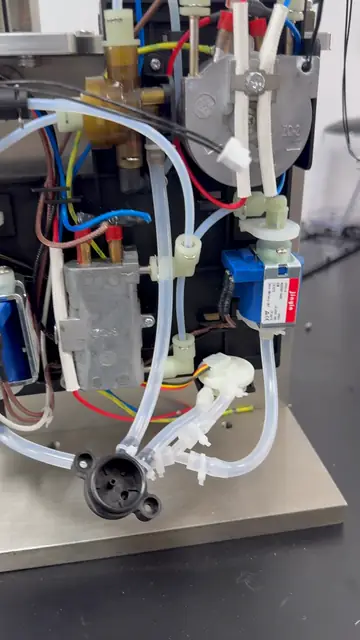
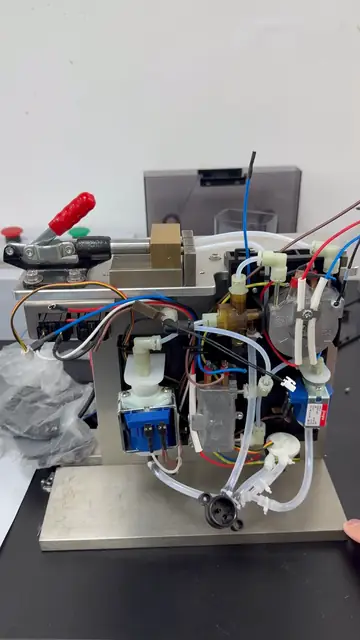
In this clip the cover is off. Water goes from the pump through a hose to the thermoblock, where the channel is a few millimetres wide. That is the first place to close, and it is replaced as a whole. The hoses and clips next to it live for years if pressure does not jump.
What to order with the machines
Per 100 machines, first year.
| Item | Offices | Cafés | Hotel rooms |
|---|---|---|---|
| Test strips | 50 | 200 | 20 |
| Cartridges | 100–200 | 400+ | not needed with bottled water |
| Descaler, doses | 200 | by technician | 100 |
| O-rings and gaskets, sets | 20 | 100 | 20 |
| Level probes or sensors | 5 | 20 | 5 |
| Pumps | 3 | 5 | 4 |
| Thermoblock or heater | 2 | 5 | 2 |
Cartridges and descaler are often bought locally. Gaskets, probes and pumps come with the container.
Who pays for scale
Scale is not a factory defect in any contract. If you sell or rent machines, put the filter and the change date into your own contract, and a photo of the hardness strip into the installation sheet. It ends most arguments before they start.
Choosing between boiler types? Water is one of the arguments in heat exchange or dual boiler.
Questions buyers ask
Is Dubai tap water good for a coffee machine?
It is desalinated and usually soft, so it is kinder than well water. Old roof tanks add sediment, so a filter is still worth it.
Can I use bottled water?
Yes in tank machines. Very soft water may confuse level probes in some models, test it on the sample.
How often should I change the filter?
By litres. Ask the cartridge maker for capacity at your hardness and divide by your daily use.
Does reverse osmosis damage espresso machines?
Without minerals it can corrode boilers and valves. Add a remineralisation cartridge.
Tell us what you need
One WhatsApp message is enough: type of machine, quantity, city. We reply with models and a price calculation.