Voltage and frequency for coffee machines in the Gulf
Five countries on 50 Hz, one on 60 Hz, some buildings on 127 V. One wrong line in the order makes a container of paperweights.
Country table
| Country | Voltage | Frequency | Plug | Order as |
|---|---|---|---|---|
| UAE | 230 V | 50 Hz | G | 220–240 V, 50 Hz |
| Saudi Arabia | 230 V, old 127 V | 60 Hz | G | 220–240 V, 60 Hz |
| Qatar | 240 V | 50 Hz | G, D in old houses | 220–240 V, 50 Hz |
| Kuwait | 240 V | 50 Hz | G | 220–240 V, 50 Hz |
| Oman | 240 V | 50 Hz | G | 220–240 V, 50 Hz |
| Bahrain | 230 V | 50 Hz | G | 220–240 V, 50 Hz |
| Iraq | 230 V | 50 Hz | C, D, G | 220–240 V, 50 Hz, plug by city |
| Jordan | 230 V | 50 Hz | C, F, G and others | 220–240 V, 50 Hz, plug by client |
Saudi Arabia is the only one of them on 60 Hz.
What inside the machine cares about hertz
- Vibration pump. A piston on a magnet. It strikes with the grid: 50 or 60 times a second. The coil and the spring are tuned for one. On the wrong frequency flow and pressure change and the coil gets hot.
- AC grinder motor. Turns a fifth faster on 60 Hz, louder and hotter, and the dose by time is wrong.
- DC motors. Do not care, they run from a rectifier. Many newer grinders are DC.
- Heaters. Do not care about frequency. They care about voltage: at 127 V a 230 V heater gives less than a third of its power.
- Boards. Usually accept both, but clocks and timers on old boards count cycles.
Why the label says 50–60 Hz
Because the board and the heater do. A label is printed for a family of versions. The pump has its own label. That is the one to photograph.
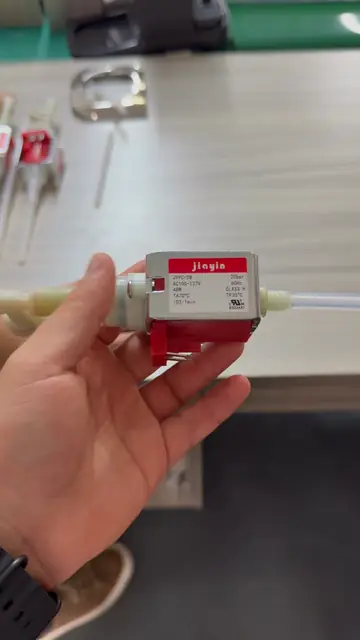
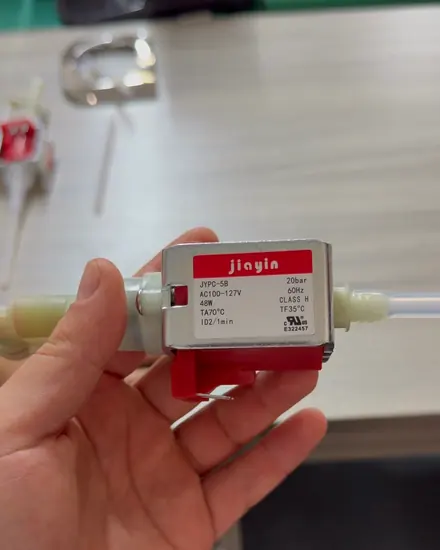
The label in our photo
It reads 20 bar, 48 W, AC 100–127 V, 60 Hz. A good pump for North America, useless in Dubai, and it looks the same as the right one. On every order we ask for the pump label of the first machine off the line, with the machine in the frame.
For Saudi orders the pump must say 220–240 V and 60 Hz. These are two conditions, and factories often meet only the first.
Which plug and cable
| Item | Ask for |
|---|---|
| Plug | Type G, moulded, with a fuse inside |
| Fuse | 13 A for machines above 700 W, 3–5 A for small ones |
| Cable | H05VV-F, 3 × 1.0 or 1.5 mm², length by room |
| Earth | Three wires, earth tested on every machine |
| Above 3 kW | No plug, fixed connection by an electrician |
| Adapter in the box | Avoid, retail customers return it |
Cable section depends on power, the test report shows which one was tested.
One container for two frequencies
It is possible and often cheaper. Conditions: separate production lots, different carton marks, two lines in the packing list, pallets of one kind on one side. Re-exporters in JAFZA do it for the UAE and the Kingdom. Forgetting a carton mark costs more than the second container.
Testing on arrival
Take three machines, brew ten double shots in a row, measure flow and touch the pump. A right pump is warm. A wrong one is too hot to hold after the fifth shot and the flow falls. Do it before the stock goes to shops.
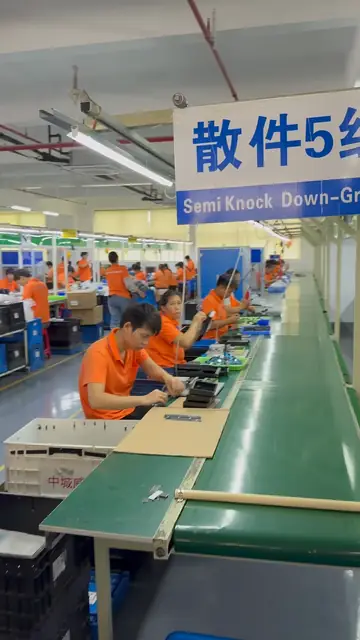
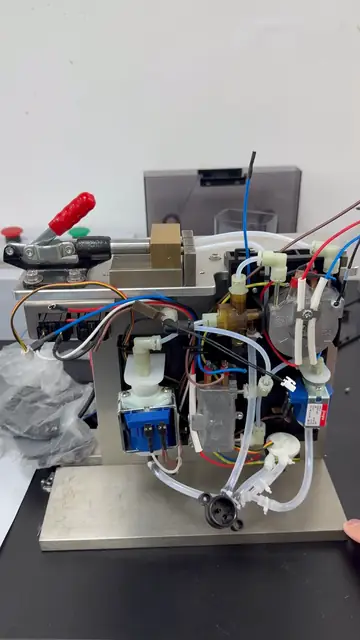
Where versions are mixed up, and where they are caught
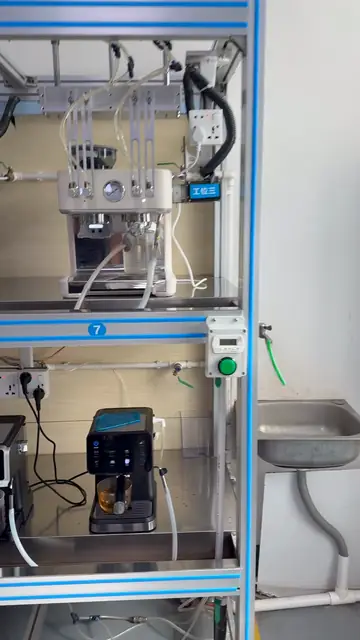
The line is where a wrong pump gets in. The bench is where it should be found.

Questions buyers ask
Can I use a UAE coffee machine in Saudi Arabia?
It heats, but the pump and an AC grinder are made for 50 Hz. For trade the label will not pass. Order the 60 Hz version.
Does a converter help?
A transformer changes volts, not hertz. A frequency converter costs more than the machine.
Which plug is used in the UAE?
Type G with three rectangular pins, like in the UK.
Is 220 V different from 230 V and 240 V?
For a machine marked 220–240 V, no. At 240 V the heater gives a little more power.
Tell us what you need
One WhatsApp message is enough: type of machine, quantity, city. We reply with models and a price calculation.